A simple answer first
An AI chatbot on a business website is a small program that talks to your visitors. A visitor types a question, the chatbot reads it, works out what the visitor wants, and replies. If it knows the answer, it answers. If it does not, it passes the visitor to a human.
That is the whole idea. Everything else is detail: where the answers come from, how the chatbot learns them, and when it should stop and hand over. This guide explains each part in plain language, with no jargon.
What a chatbot does
A chatbot on a business website does three jobs.
It answers questions. Opening hours, prices, services, delivery areas, booking information. The questions visitors ask again and again. A good chatbot answers these in seconds, at any time of day.
It books appointments. When a visitor wants to book, the chatbot can take the details and confirm a time, or pass the request to the booking system. It does not need a person sitting at a desk for this to work.
It hands over to a human. When a question is too complex, too sensitive, or simply not in the information the chatbot was given, it should say so and bring in a person. A good chatbot knows its limits. That handover is not a failure. It is the design working as it should.
These three jobs are why businesses use chatbots. They do not replace people. They handle the routine work so people can handle the work that needs a person.
How a chatbot learns
A chatbot does not know anything about your business until someone teaches it. That teaching is called training, and it uses your own information.
Training starts with what your business already has: your website pages, your list of services, your prices, your frequently asked questions, and your policies. The chatbot is given this information and taught how to find the right answer when a visitor asks about it.
For example, if a visitor asks “Do you work on Saturdays?”, the chatbot needs to know your working hours. If it asks “How much does it cost?”, the chatbot needs your pricing information. If that information is missing, outdated, or wrong, the chatbot will give a missing, outdated, or wrong answer. The quality of a chatbot is limited by the quality of the information it is trained on.
That is why chatbot development services always start with the business, not with the technology. Before any chatbot is built, the business has to gather its information in one place, decide what the chatbot should answer, and decide what it should never answer. A custom chatbot development service builds the chatbot around that information, so the answers sound like your business, not like a generic machine.
Training is not a one-time job. Businesses change. Prices change, services change, hours change. Every time something changes, the chatbot’s information has to change with it. A chatbot that is not updated slowly becomes a chatbot that gives wrong answers. Part of running a chatbot is keeping its information current.
A conversation, step by step
Here is what happens when a visitor talks to a chatbot on a website.
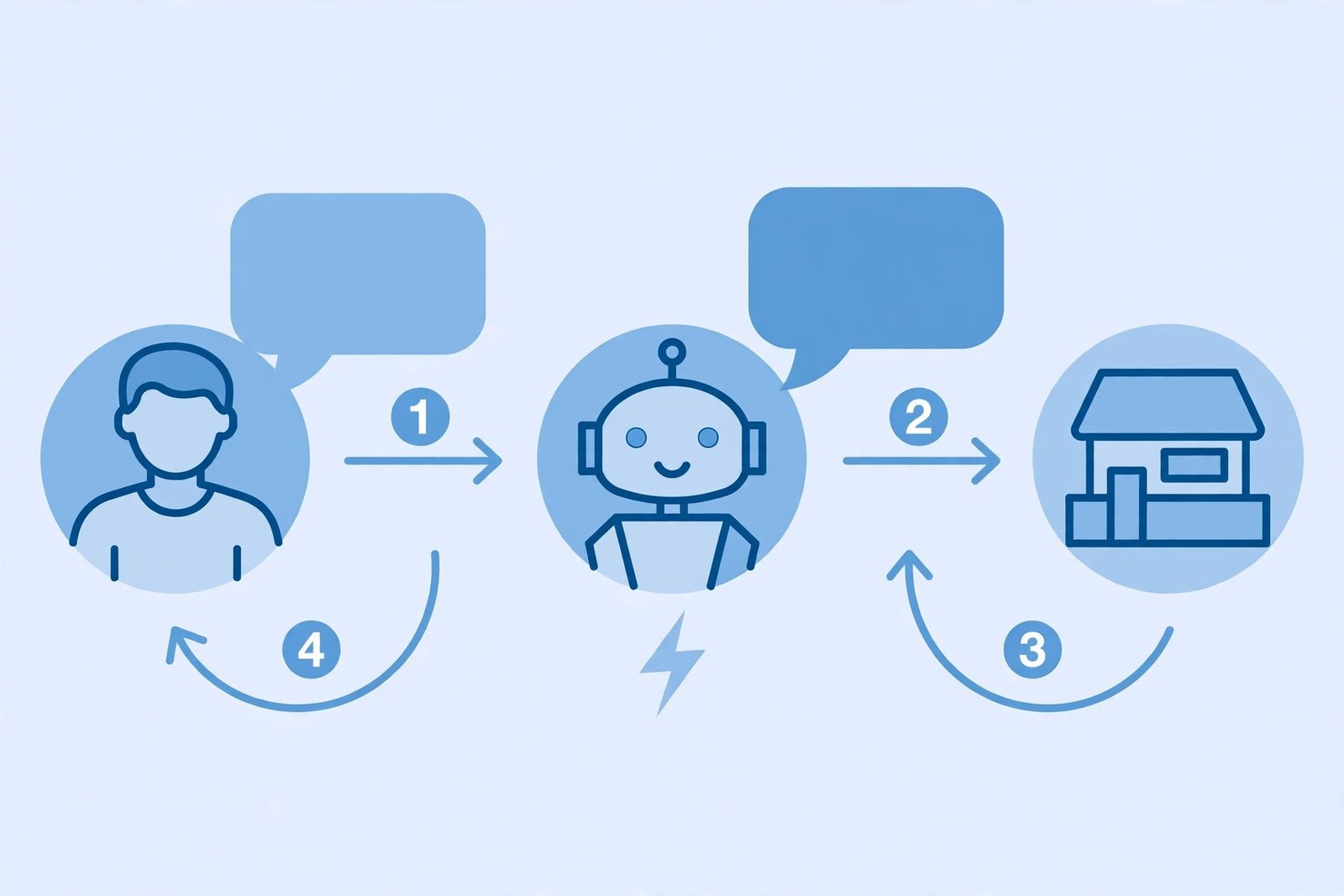
1. The visitor asks a question. They type it in plain language, the way people actually write: “Are you open on Sunday?” or “How do I book an appointment?” or “Do you deliver to Richmond?”
2. The chatbot reads the question. It looks at the words and works out what the visitor is asking about. It does not need the exact words. “Are you open Sunday”, “Do you work Sundays”, and “Sunday hours” are the same question to a chatbot that has been trained properly.
3. The chatbot finds the answer. It searches the information it was trained on and picks the best match. For a simple question, the answer comes from a page, a fact, or a set of instructions the business gave it.
4. The chatbot replies. It answers in plain language, and often offers a next step: a link to a booking page, a phone number, or a button to talk to a person.
5. The chatbot hands over when it should. If the visitor’s question is outside what it knows, or the visitor asks to speak to a person, the chatbot passes the conversation to a human, along with what has already been said. The person does not have to start from the beginning.
This whole exchange takes seconds. That speed is the point. A visitor who gets an answer in seconds stays on the website. A visitor who waits for an email reply may not come back.
Where a chatbot fits
A chatbot fits best in three situations.
After-hours questions. Your website gets visitors at night, at weekends, and on holidays. A chatbot answers them when nobody is in the office. It does not close at five o’clock.
Repeated questions. Every business gets the same questions over and over. Opening hours, prices, locations, booking, delivery. A chatbot answers these every time, the same way, without getting tired or annoyed.
Simple tasks. Booking an appointment, checking availability, pointing a visitor to the right page, taking a name and a number for a call back. These are small jobs that a chatbot can do reliably.
If your business gets a lot of these, a chatbot saves real time. It also helps your customers, because they get answers when they want them instead of when you are available.
Where a chatbot does not fit
A chatbot does not fit everywhere, and knowing where it does not fit matters as much as knowing where it does.
Complex complaints. A customer with a serious problem wants a person, not a machine. A chatbot that tries to handle a complaint badly makes the problem worse. Complaints should go to a human, quickly.
Anything needing a human decision. Refunds, exceptions, judgement calls, anything where the right answer depends on the situation and not on a rule. A chatbot follows rules. A person makes decisions.
Sensitive conversations. Health, money, legal matters, anything personal. Visitors do not want to explain something sensitive to a program. They want a person who can listen.
Questions with no answer in the training. If the chatbot was never given the information, it should say so and hand over. A chatbot that guesses is worse than a chatbot that admits it does not know.
A good chatbot development service will tell you this before you buy. If someone offers you a chatbot that claims to handle everything, be careful. The honest promise is narrower: it handles the routine work well, and it hands the rest to a person.
What a good chatbot needs
Four things decide whether a chatbot works well or badly.
Accurate information. The chatbot is only as good as what it was trained on. Wrong prices, old hours, and missing services become wrong answers.
A clear handover. Visitors must always be able to reach a person. A chatbot with no way out is a trap, and visitors remember it.
Regular updates. The information behind the chatbot has to be updated whenever the business changes. This is ongoing work, not a one-time setup.
Measurement. The business should be able to see what visitors ask, what the chatbot answered, and where it handed over. That shows what is working and what needs more training. Chatbot development solutions that include this reporting are worth more than ones that do not, because they get better over time instead of slowly going stale.
How a chatbot connects to the rest of the business
A chatbot does not have to work alone. It can connect to the other tools a business uses.
It can send booking details into a calendar, pass a lead into a CRM, or log a question for the team to follow up. When it connects to business automation, the work it starts can carry on without anyone retyping it. A visitor who books through the chatbot can get a confirmation automatically. A lead the chatbot collects can go straight into the follow-up system.
This is where a chatbot becomes part of the business instead of a gadget on the website. The chatbot answers the visitor. The automation carries the result forward. The person handles the part that needs a person.
If you want to know what a chatbot could do for your business, see our AI chatbot development services page.
Frequently asked questions
What is chatbot development?
Chatbot development is the work of building a chatbot for a business: gathering the business’s information, training the chatbot on it, connecting it to the website, and setting up the handover to a human. It includes the design of the conversation, the answers the chatbot gives, and the reporting that shows how it performs.
Does a chatbot replace my staff?
No. A chatbot handles routine questions and simple tasks. Your staff handles everything else: complex questions, complaints, decisions, and the work that needs a person. Most businesses find the chatbot takes work off their staff rather than replacing them.
Can a chatbot answer questions at night?
Yes. That is one of its main uses. A chatbot on your website answers visitors at any time, including nights, weekends, and holidays, when nobody is in the office.
What happens when the chatbot does not know the answer?
A good chatbot says so and hands the visitor to a human, passing along what has already been said. It should not guess. The handover is part of the design.
The short version
An AI chatbot on a business website reads a visitor’s question, finds the answer in the information it was trained on, and replies. It answers routine questions, books appointments, and hands over to a human when it should. It is trained on your own business information, and it needs that information kept up to date. It fits after-hours questions and repeated questions. It does not fit complaints, decisions, or sensitive conversations.
If that sounds useful for your business, contact us and tell us what your visitors ask most. We will tell you honestly whether a chatbot fits, what it would do, and what it would cost.
*WebMagnify Agency: AI chatbot development services for Virginia businesses. Serving Norfolk, Richmond, Virginia Beach, and businesses across Virginia. Back to the homepage.*